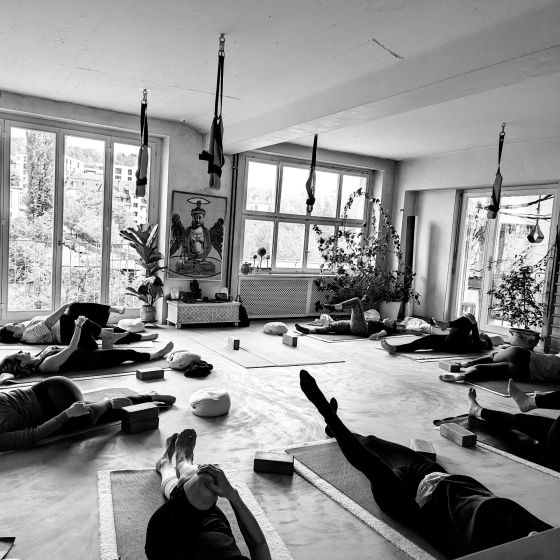
of effort and surrender.

we can approach practice from a functional perspective, using tools, learning the ,how to‘ and ‚why‘.

and we can approach practice without purpose, as a self-sufficient process. relationship, interdependence, play.

and both sides are valuable, we don‘t have to choose one over the other. we practice techniques to come into well-being of some sorts and we practice just for the sake of practice. both are liberating paths.

but I think it is crucial to know, really know both perspectives. so that this understanding creates wisdom, creates access to deeper levels of connection, deeper levels of being in this world right now.

Sometimes good things sneak in through the back door, while we’re busy being wary of bad things coming from the front.

taking refuge.

There‘s this expression of taking refuge – taking refuge in the dharma, the sangha, the buddha. And I never really took a closer look, but recently in a talk the issue of taking refuge came up for me.

Because we all take refuge. We take refuge in media. In substances. In fantasies. We do it more or less consciously, but we do it all the time. And this is worth checking out, because that‘s where we turn away from something and towards something else.


Is this what we want?

can we.

I think of patterning these days, of how our actions and thoughts are shaped by numberless factors coming together and falling apart. in yoga land called samskaras or sankharas in pali.

and the most painful pattern, I heard someone say, is the one we know very well, but cannot help but repeat.

so, can we establish a baseline from where to act, that is rooted in contentment, rather than its opposite. a baseline of courage, of friendliness. so that the patterning unfolds on another ground. can we contribute to those forces that build and fuel patterning in a way that leads to other results than the way we know and repeat again and again? and can we be specific in that?

today I thought about how long we gravitate around the essentiality of our lives, the difficult questions we like to overlook because we‘re too afraid of facing them. of how long we entertain ourselves, fascinated by the shiny, the mysterious, inventing new stories, new selves. of how long it takes us to stop and fall into our own lives.

Your practice is yours and yours alone. It’s a deeply personal, private experience. Your motivations don’t need to be justified or rationalized. You don’t need to impress your students, your teachers, your peers, or the community. Just follow your own motivation to practice and enjoy yourself. It’s yours.

Jason Crandell

‚When I was in China in the Zen monastery, one time I was reading the sayings of an ancient master. A monk from Szechuan asked me: What’s the use of that? What’s the use of reading?

I said: When I go home, I want to be able to guide people.

The monk asked: What’s the use of that?

I said: For benefiting all sentient beings.

The monk said: In the end, what’s the use of that?

Later I thought about this conversation and realized that studying the sayings and stories of ancient masters and expounding them for deluded people is of no use in awakening ourselves and guiding others.

If you sit and clarify the great matter and understand the essence, the power of this is boundless and awakening others, even without reading one word.

I think that is why the monk said: In the end, what’s the use of that?

So afterward I stopped reading the recorded sayings of old masters and just sat still.‘

– Dogen

From a talk of Michael Stone

resting on the ground of what is.

it’s not what we want. or not want. that keeps us from being.

the wanting itself creates the tension.

when wanting falls away. we rest on the ground of what is.

the inner nature of things

„the knowing through experience is much more profound than the intellectual unterstanding.

allow the understanding to come from experience, it’s the experience that touches us in deep places, it’s that being touched that brings about transformation.

being touched very deeply allows the letting go.“

from a talk of norman feldman.

most intimate.

Sitting quietly,
one minute, one hour, no matter,
finding the quiet within
I find myself again and again.

Finding myself, I offer the quiet light
to those on the street, in the office,
all around me.

To the lost and suffering beings, to the bewildered
and questioning,
even to the bare tree with its leafless
branches filled with chirping sparrows.

From „Most intimate“ / Roshi Pat Enkyo O‘Hara